
How to Repair a Leaking Commercial Roof Without Tearing It Off
Compare silicone, polyurea and spray foam roof restoration, including EPDM, TPO and PVC compatibility, Uniflex warranty options, moisture inspection and when tear-off is necessary.
A leaking commercial roof does not automatically mean the entire assembly needs to be torn off. In many cases, an existing roof that remains structurally sound, dry and sufficiently adhered can be repaired and restored using a properly designed fluid-applied system. In other cases, a coating will simply conceal a deeper problem and delay the inevitable replacement.
The question is not whether silicone or polyurea can form a waterproof membrane. Both technologies can be excellent choices in the correct application. The question is whether the existing roof is suitable for restoration, what the new system must accomplish, and how the owner can verify that the specified work has been completed.
This guide is designed to help facility managers, building owners, engineers and purchasing professionals compare roof restoration options before requesting a proposal.
Can I stop a commercial roof from leaking without replacing it?
Yes, when the source of leakage can be corrected, the existing assembly is an appropriate substrate, and the applicable code and system manufacturer allow it. A fluid-applied roof restoration can address deteriorated seams, flashings, penetrations and the weathered surface of a compatible existing roof without removing every layer. A spray polyurethane foam (SPF) roofing system with a protective coating can also add insulation where the existing roof is approved for recovery.
However, three conditions should never be ignored: water trapped within the roof, structural deterioration and an existing assembly that is no longer adequately attached. A new waterproof layer cannot restore the strength of a failing deck or make soaked insulation dry. Adding an impermeable or low-permeability layer over moisture can make later damage harder to detect.
The International Existing Building Code roofing provisions illustrate restrictions on roof recovery where the existing assembly is water-soaked or too deteriorated to support further roofing. The linked text is a California adoption of the model code; the applicable local code, amendments, existing roof layers and classification of the proposed work must be confirmed for the actual building. A maintenance coating and a roof recover may be treated differently.
First locate the leak, then determine the scope
An indoor drip rarely gives the complete picture. Water entering at a rooftop penetration may travel along the deck, insulation joints or structural members before appearing inside. Rain driven by wind can enter at a perimeter or wall transition that remains dry during ordinary rainfall. In cold weather, condensation can produce interior drips even when the exterior membrane is watertight.
Document when and where the problem occurs. Does it happen during heavy rain, wind from a particular direction, snowmelt or a large temperature change? Is the interior water near a mechanical curb, drain, roof-to-wall junction or a plumbing system? Have prior repairs moved the symptom rather than eliminated it?
A qualified roof inspection can establish the likely water-entry paths, surface condition, attachment, drainage and details. A moisture survey may identify suspect wet insulation. Infrared imagery or other screening methods should be interpreted in the context of weather, roofing material and assembly design; confirm suspect conditions using appropriate inspection methods. The roof owner and qualified personnel should decide whether any areas need opening and how to safely restore them.
Do not access an unsafe roof or walk on suspect deck areas. Active leakage near electrical equipment, sagging ceilings, falling materials and compromised structural members should be addressed through the facility's safety and emergency procedures.
When localized repairs make sense
A few isolated failed details on an otherwise sound roof may not justify coating the entire building. A damaged flashing, open seam or failed penetration could be treated with a manufacturer-approved detail compatible with the existing membrane. A roof that already has significant widespread deterioration may require a larger scope.
Repeated patching without a documented assessment can become expensive. Keep a roof map and maintenance record showing each leak location, repair and recurrence. If leaks multiply or repairs repeatedly fail, reassess the roof as a system, rather than continue to add different sealants.
When a coating or SPF recover is a reasonable option
Restoration becomes attractive when the roof assembly remains suitable, but its weathering layer or details need renewal. The owner may be able to avoid unnecessary removal and disposal, preserve usable insulation, reduce disruption and install a new continuous protective surface. These advantages are conditional on the existing roof and approved design.
A coating-only project generally does not meaningfully increase the assembly's thermal resistance. If heat loss, condensation or energy performance is also a problem, a designed SPF recover or another insulation improvement may be more appropriate. Roof elevations, door clearances, drain heights, curbs, perimeter edges, equipment support, wind uplift and fire classifications all need to be reviewed if the roof thickness changes.
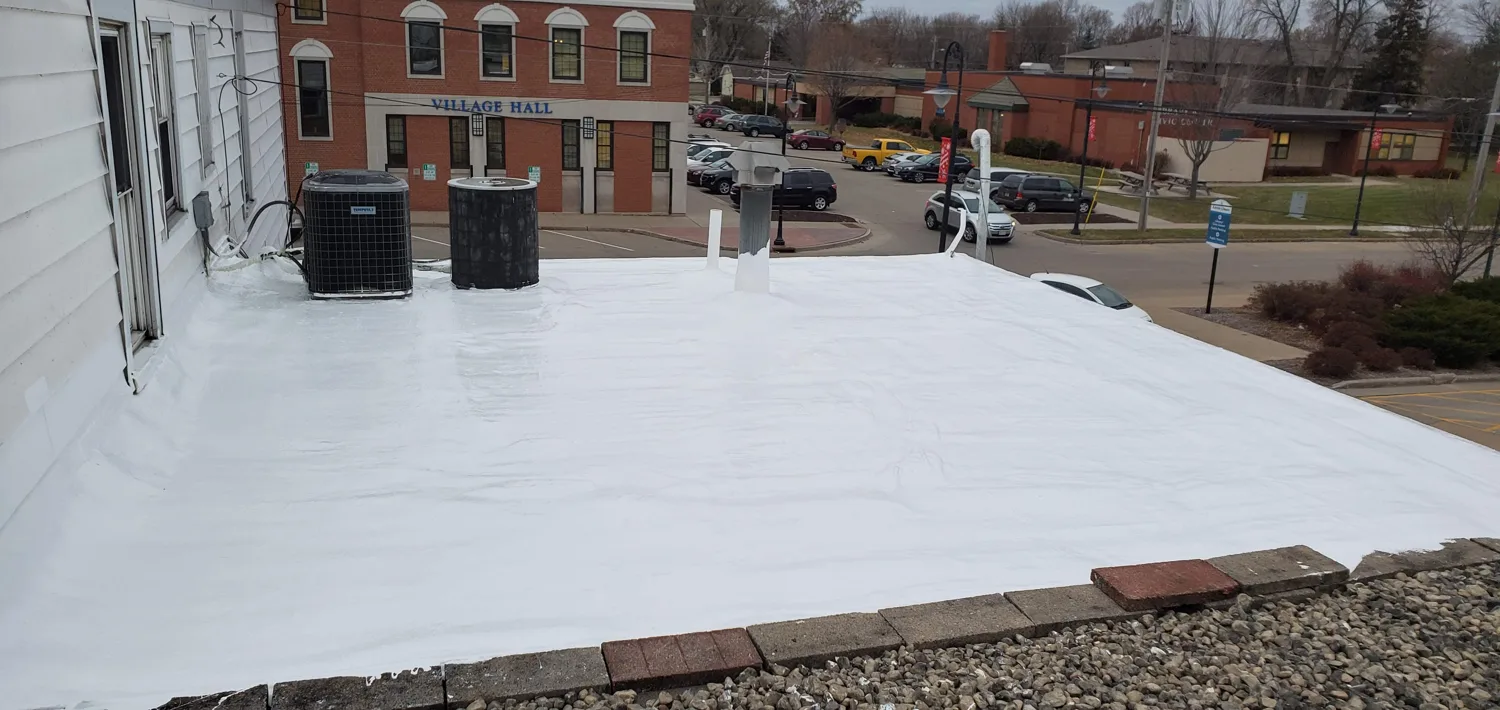
Actual project: Little Chute, Wisconsin. An approved portion of an existing EPDM assembly was retained, with spray foam insulation and a silicone finish.
At our Little Chute mixed-use roof restoration, the building had leaks and inadequate thermal performance above a coffee shop and apartments. Sound areas of the existing EPDM were retained, while loose or unsuitable material was removed. The project included three inches of three-pound closed-cell spray foam and a silicone finish. That thickness was specific to this building; it is not a blanket recommendation for other roofs.
What roof surfaces can be restored?
Commercial roofs are made of different materials, and the preparation and attachment requirements are not interchangeable.
EPDM rubber roofing
EPDM is an elastomeric, thermoset single-ply membrane commonly encountered on commercial roofs. It can be a good restoration candidate when the membrane and supporting assembly remain sound. An older roof may have weathering residue, previous repair products, deteriorated seam tapes or contaminated areas that affect adhesion.
The contractor should identify the actual membrane, determine whether repairs or replacement are necessary at seams and flashings, and establish the cleaning and primer requirements through the approved specification and adhesion testing. A coating that adheres well to a particular EPDM roof may not behave the same way on another aged membrane.
TPO roofing
Thermoplastic polyolefin roofing uses heat-welded seams and can be restored with compatible systems when the existing roof meets the manufacturer's requirements. Weathering, surface contamination, seam defects and earlier repairs must be evaluated. Do not assume that the primer and surface preparation for EPDM will also be appropriate for TPO.
PVC roofing
Polyvinyl chloride roofing is another thermoplastic single-ply membrane. Material compatibility and surface preparation are especially important when considering an overlay. The manufacturer should confirm the intended coating and primer for the specific membrane in its current condition. Different formulations and prior treatments can affect adhesion. Review any existing warranty before applying a different manufacturer's products.
Uniflex's single-ply Silicone44 system summary explicitly covers EPDM, TPO and PVC. It calls for adhesion testing, moisture evaluation, correction of defective membrane details, removal of wet insulation and preparation before the finish coating. It notes that EPDM may need a specific wash primer depending on the adhesion result. Consult the full specification rather than treating a product label as approval for every roof.
Metal roofing
Commercial steel roofs may leak where panels overlap, fasteners deteriorate, ridge caps move or penetrations lose their seals. Corrosion can also compromise the metal itself. Inspect the supporting metal and attachment before deciding whether a coating restoration is sufficient. Replace or repair structurally compromised components as required. Coatings are not structural reinforcement.
Metal roof panels undergo thermal expansion and contraction. A coating system must accommodate the expected movement at the approved details. Reinforced treatments at seams, fasteners and transitions are often part of a specification, but they should not be used to immobilize a joint designed to move independently.
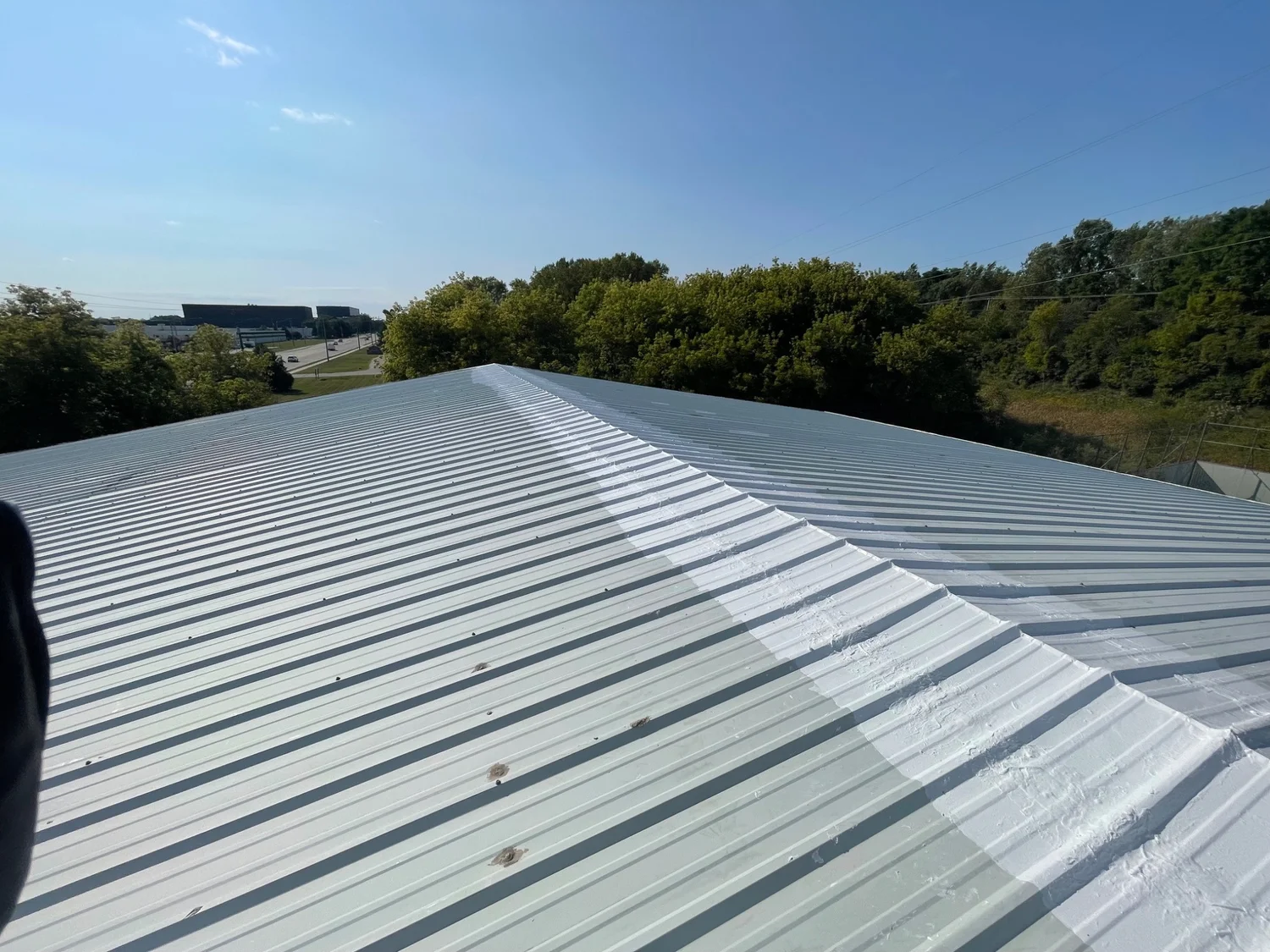
Actual project: a leaking ridge on a steel roof in Sussex, Wisconsin.
Our Sussex steel roof leak repair involved Gaco patch material, reinforcing fabric and two coats of Gaco silicone at the affected area. This shows the role of a properly detailed seam repair, rather than just applying a coating to the visible roof surface.
Existing spray foam, modified bitumen and other roofs
Existing spray foam roofs often have an elastomeric finish that needs periodic examination and renewal. The exposed coating protects the foam from weather and sunlight. A compatible recoat may be practical if the underlying foam is in acceptable condition. Damaged, wet or poorly adhered sections need evaluation and repair.
Some modified bitumen, smooth built-up roofing and certain other assemblies may also be eligible for restoration. Asphalt bleed-through, surface granules, existing coatings, roof layers and adhesion can affect the choice. Refer to Uniflex's substrate-specific system specifications for examples of how different systems are specified.
Silicone roof coatings: what makes them useful?
Silicone is commonly used as a fluid-applied roof coating because suitable formulations can resist outdoor weathering, remain flexible and create a continuous membrane. High-solids silicone systems can also be attractive on low-slope roofs where water remains for extended periods. Product suitability, however, does not eliminate the need for functional drainage.
Uniflex Silicone44 white 44-600 is a representative example. Its manufacturer technical information lists 94% volume solids, 127% elongation, tensile strength of 177 psi and initial solar reflectance of 0.88. These figures are for that particular product, not all silicone coatings. Color, formulation, test conditions and aging can change performance. Always obtain the current data for the exact product proposed.
A bright white reflective finish can help reduce solar heat absorption. The benefit to a building's cooling load depends on its location, roof insulation, exposure, existing color and operating conditions. A coating does not replace insulation, and lower roof surface temperatures do not mean a guaranteed reduction in utility costs.
Silicone also has practical limitations. The surface can be slippery when wet; foot traffic needs a suitable walkway or protection system. The previous coating influences whether future repair materials will bond. A silicone system should not be specified with an expectation that arbitrary paint, sealant or roofing materials can later be applied over it.
Uniflex Silicone44 warranty options: 10, 15 and 20 years
A warranty term should be tied to a manufacturer-approved system and actual eligibility, not stated as a generic promise about a bucket of coating. Uniflex publishes different systems depending on the existing roof material and the type of project.
For eligible single-ply systems, the Uniflex single-ply system summary gives these finish-coat application targets:
- 10-year system: 1.5 gallons per roofing square (100 square feet), equivalent to approximately 24 wet mils.
- 15-year system: 2.0 gallons per square, approximately 32 wet mils.
- 20-year system: 2.5 gallons per square, approximately 40 wet mils.
The wet-film amounts are not the dry film thickness. At a nominal 94% volume solids, the simplified theoretical dry-film thicknesses are approximately 22.6, 30.1 and 37.6 mils, respectively. Actual installed requirements and consumption are determined by the specification, substrate, surface texture, application losses and field measurements. One mil equals 0.001 inch.
Uniflex distinguishes material warranties from system warranties. Its single-ply summary identifies 10- and 15-year material options, and 10-, 15- and 20-year system options. For the system warranty, the document specifies prior approval, a fee and an approved applicator. The purchaser should obtain the actual written warranty, including the scope of coverage, approved assembly, exclusions, maintenance obligations and inspection requirements. Neither the stated term nor the coating application rate implies every roof is eligible.
The manufacturer's warranty options chart and system specifications are useful starting points. Warranty availability, product versions and terms may change. Existing SPF, new SPF, metal and asphaltic roofs cannot automatically be assigned the same term as an eligible single-ply assembly.
What should I ask before accepting the warranty?
- Is the proposal offering a material-only warranty, a contractor workmanship warranty or an issued manufacturer system warranty?
- Who pays for the inspection, fee and any required corrective work before issuance?
- Is the existing roof, including prior coatings and repairs, eligible for the specific system?
- What thickness, material types, detail treatments and documentation are required?
- What periodic inspection and maintenance is the owner expected to perform?
- How are excluded conditions, third-party roof damage, equipment installation, transfer to another owner and claims handled?
For example, Uniflex's metal roofing system specification describes manufacturer inspection before issuance and owner maintenance obligations. The project-specific warranty document, rather than marketing language, controls the actual coverage.
How much coating would a 40,000-square-foot roof require?
As an illustrative purchasing calculation, a 40,000-square-foot roof contains 400 roofing squares. At the single-ply finish-coat rates above, nominal material amounts are 600 gallons at 1.5 gallons per square, 800 gallons at 2.0, and 1,000 gallons at 2.5. Those quantities are not complete material takeoffs: detail materials, surface texture, repairs, application losses, any required primer and actual specification must be considered.
This is one reason to compare proposals on the application rate and complete scope rather than the number of coats alone. Two coats at a low rate may deliver less material than a single specified high-build application.
Polyurea waterproofing: a different high-build approach
Pure polyurea is a family of reactive polymer coatings capable of forming durable elastomeric membranes. Certain hot spray-applied products can build a relatively thick layer rapidly, including around complex shapes. Other polyurea formulations are designed for slower application methods. Chemistry, physical properties, weather resistance and approved applications differ significantly.
For roofs, the polyurea must be intended for the proposed exposure and assembly. Some systems are approved specifically for roof waterproofing; others are intended for tank lining, secondary containment, industrial floors or other applications. A tank coating is not automatically an approved roof membrane. The contractor must establish suitable preparation, primer, detailing, thickness, UV exposure requirements and applicable roof assembly approvals.
The Insurance Institute for Business & Home Safety SPF roofing guide describes several elastomeric protective coatings over spray foam and discusses polyurea as one option. It emphasizes the importance of the actual formulation and manufacturer information.
Why we prefer aliphatic coatings for exposed polyurea systems
Polyurea systems may be based on aromatic or aliphatic chemistry. Aromatic membranes can offer strong waterproofing and mechanical performance, yet some require protection when exposed to sunlight. Depending on the product, UV exposure can affect color, gloss, surface condition and potentially performance. A suitable aliphatic finish is designed for better UV and color stability.
Green Peak prefers an aliphatic protective system for externally exposed polyurea applications. That can mean a suitable aliphatic membrane or an approved aromatic membrane with an aliphatic topcoat, depending on the engineered and manufacturer-approved specification. The topcoat must be compatible with the underlying membrane; it is not simply an optional paint.
Sika's Sikalastic-833 R roof membrane data sheet provides a manufacturer example of a pure spray-applied polyurea roof membrane that requires an appropriate aliphatic finish on fully exposed roofs. ACE UV Shield is an example of a manufacturer-described pure aliphatic polyurea. These are examples of available technologies, not statements that Green Peak has used or is recommending those specific products for your roof. Local availability and approval for US roof assemblies must be verified.
How thick should a polyurea roofing membrane be?
For a suitable exposed high-build polyurea roof system, Green Peak generally recommends evaluating a 100-plus-mil membrane specification with a UV-stable finish. One hundred mils equals 0.1 inch or 2.54 millimeters. The actual target must comply with the coating manufacturer's approved system, construction details, intended service, roof design and warranty. More thickness is not automatically better if it exceeds a product's approved application parameters.
Published product guidance illustrates the differences. The Sika roof membrane cited above reports a nominal thickness of approximately 2 mm, about 79 mils, for its system. That figure is not a Green Peak installation target or permission to alter the manufacturer's design. It demonstrates why thickness must be considered for each approved product and assembly.
Does polyurea really wear by less than one mil per year?
Green Peak's field experience informs our preference for durable, high-build exposed polyurea applications. However, we do not treat an annual wear figure of less than one mil as a universal specification or promise. Published service life, abrasion testing, accelerated weathering and measured field thickness are different types of evidence.
A roof's actual wear depends on the product, exposure, pedestrian and equipment traffic, weathering, erosion, cleaning and other conditions. A 100-mil coating cannot therefore be represented as automatically lasting 100 years by dividing thickness by an assumed annual wear rate. The failure of a seam, penetration or area of poor adhesion can require repair even if most of the membrane retains its original thickness.
For an owner who wants measurable long-term evidence, agree on baseline inspection records, periodic examinations and any meaningful thickness measurements applicable to the system. Monitor the highest-use and most exposed locations rather than relying on a single average.
What about polyurea warranties?
There is no universal 10-, 20- or 30-year polyurea roofing warranty. The warranty depends on the manufacturer and approved assembly, sometimes the specific contractor, application records, project inspection and ongoing maintenance conditions. A product data sheet reporting elongation, weathering performance or expected service life is not the same as an enforceable roof warranty.
Before purchasing, obtain written confirmation of the specific membrane and topcoat system, roof substrate, scope of coverage, required approval process and warranty document. Ask whether leak repair labor, materials and consequential damage are covered, and what exclusions apply. Green Peak will evaluate a suitable system for the roof in question; specific warranty commitments must be established in the proposal.
Elongation: silicone and polyurea can accommodate movement, but what does that mean?
Elongation describes how much a material extends relative to its original length in a specified test. An elongation at break of 100% means the specimen reaches twice its original length before breaking under the test conditions. A value of 400% means it reaches five times its initial length. This is a laboratory test interpretation, not the movement an installed roof joint can safely accommodate.
The Uniflex Silicone44 44-600 product information reports 127% elongation. The ACE UV Shield manufacturer page reports 205% ±10% for its pure aliphatic polyurea. Tecnopol's P-2049 EL membrane reports more than 600% at 23°C for a particular aromatic formulation and specifies UV protection for exposed use. These test values indicate substantial flexibility, but they are not interchangeable design values or a direct ranking of installed systems.
A high elongation value alone does not establish crack-bridging, resistance to repeated movement, tear strength, adhesion, low-temperature behavior or the performance of a membrane bonded to a roof. The joint geometry and distribution of strain matter. A structural expansion joint is not a narrow surface crack. The approved roof design should identify which details require independent movement, reinforcement or another specialized solution.
The same matters when comparing tensile strength, hardness, abrasion resistance, water absorption and vapor permeability. Use the actual test methods, conditions and system documentation. A material that scores highly in one test may not be the better option for a particular roof.
What about ponding water and flat roofs?
Low-slope commercial roofs often collect water in depressions or around poorly functioning drains. A suitable silicone or polyurea system can be selected for water exposure, but coating performance is not permission to ignore drainage or structural loading. Water adds weight. Persistent ponding may indicate blocked drainage, deficient slopes or structural deflection.
A qualified roof professional should inspect primary and overflow drainage, low points, scuppers, gutters, roof equipment and parapets. If persistent ponding suggests structural or design problems, involve the appropriate engineer. Do not assume a coating will solve inadequate slope or load-bearing capacity.
Some SPF roof designs can be used to improve insulation and modify the drainage profile, subject to design review. Adding foam changes roof height and geometry; penetrations and perimeter conditions must be evaluated. The finished foam requires its approved protective surface.
When is removing the existing roof necessary?
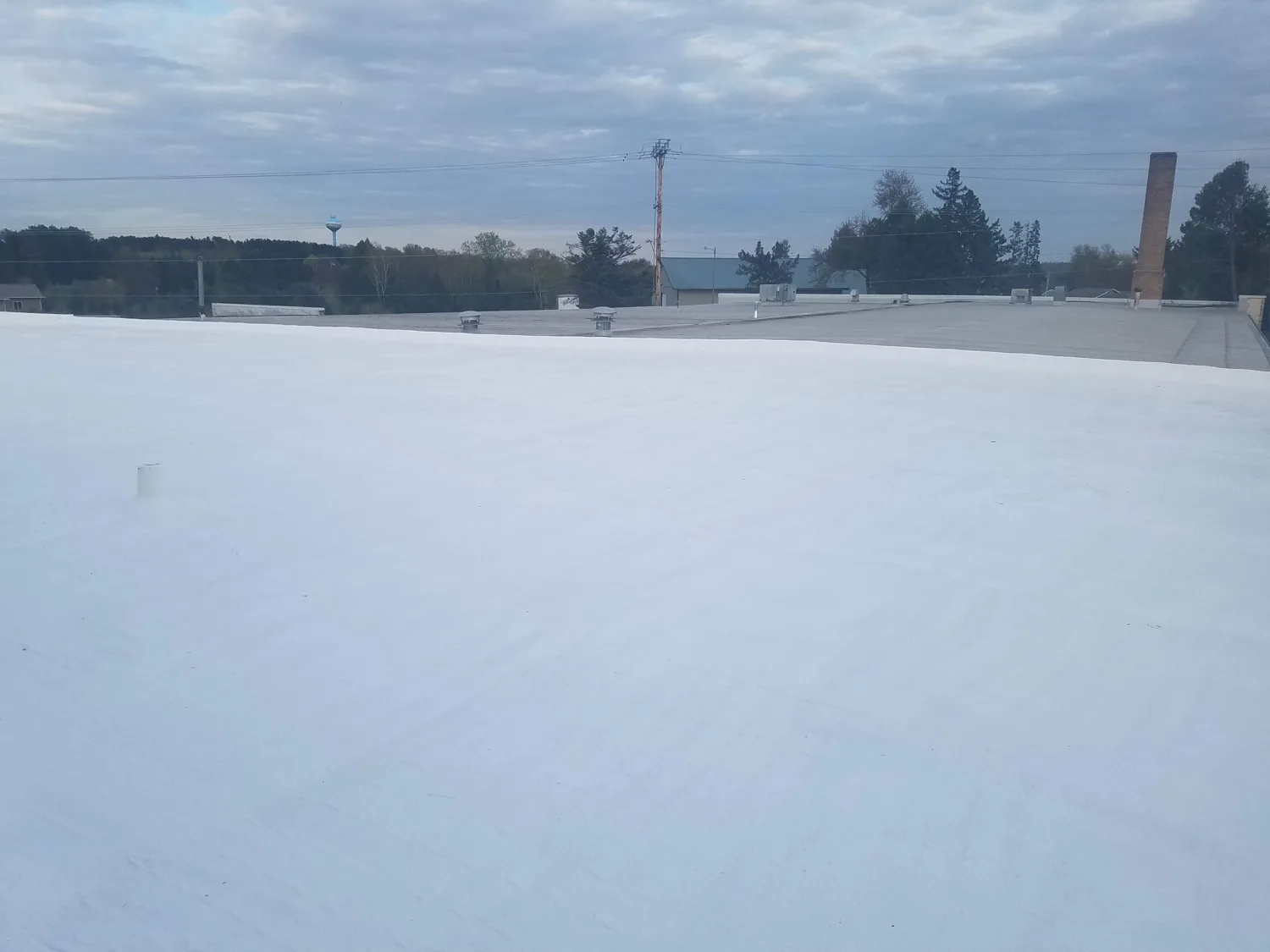
Actual project: Hortonville, Wisconsin. The existing deteriorated materials required removal before the new foam and silicone assembly was installed.
Our Hortonville spray foam and silicone roof restoration was not a simple overlay. The original EPDM and underlying insulation were deteriorated, and part of the existing deck required replacement. The new system included 1.5 inches of three-pound closed-cell foam and two coats of silicone. This is an example of why we examine the actual building rather than promise restoration without tear-off in every case.
A selective or full tear-off is worth considering when inspection identifies wet insulation, deteriorated decking, widespread attachment problems, incompatible roof layers or defects that cannot be addressed through the proposed restoration. Code and roof assembly approvals may also limit recovery. When local damage is found, determine whether only affected portions can be removed and restored, or whether the condition is widespread.
If the roof is already under warranty, consult the existing manufacturer before making changes. Insurer and building owner requirements can also affect which assemblies are acceptable.
What should be included in the contractor's scope?
A useful specification covers more than a manufacturer's product name.
- An inspection identifying the existing roof, condition, approximate dimensions, prior repairs, and the affected details.
- Moisture evaluation and a plan to investigate or remove unsuitable materials.
- Written suitability of the proposed coating system and the existing substrate, including compatibility testing.
- Identified repairs for deficient seams, fasteners, flashings, drainage, penetrations and terminations.
- Defined environmental limits, surface preparation, primers, roof coating and specified application rate or thickness.
- Roof safety, access and equipment, protection of neighboring surfaces and processes, weather planning and cleanup.
- Verification of film thickness, adhesion, visual condition and other inspection criteria where applicable.
- The warranty requested, provider, approval requirements, exclusions and owner maintenance obligations.
Ask the contractor to identify allowances for areas of wet insulation or damaged deck that can only be confirmed later. The estimate should explain what constitutes a change in scope, how the change will be documented and who approves it.
How much does commercial roof restoration cost compared with replacement?
A restoration can avoid removal and disposal of usable material, but a simple per-square-foot comparison can be misleading. The cost depends on preparation, repairs, roof access, membrane and insulation condition, detail complexity, geometry, coating choice, thickness, logistics and warranty. Replacement may require demolition, new insulation, new membrane, edge metal, mechanical coordination and greater interruption to building operations.
Consider multiple options over a common planning period. If restoration is suitable, compare the proposed installation, future maintenance, anticipated renewals and warranty conditions against the expected replacement scope. If widespread wet insulation or deck problems exist, replacement costs may be more predictable than repeated repairs to a compromised assembly.
Ask for alternatives based on actual inspection: localized repairs, full coating restoration, an approved SPF and coating system, or selective/full replacement. Make sure each bid explains the scope and limitations. A cheaper scope that leaves moisture and defects unresolved may be the most expensive option over time.
Frequently asked questions
Can silicone be applied directly over EPDM, TPO or PVC?
An approved coating system may be suitable, but the membrane's condition and prior treatments determine the preparation and primer. Obtain manufacturer guidance and representative adhesion test results. Repair defective areas first.
Can polyurea be installed over silicone?
Do not assume compatibility. Silicone surfaces can be difficult for unrelated materials to bond to. A qualified manufacturer-approved preparation, compatible primer and successful adhesion evaluation are needed, and some systems may require removal.
Will a white silicone roof keep a building cooler?
A reflective coating can reduce roof solar heat absorption. Actual indoor or energy performance depends on insulation, climate, HVAC operation and other factors. A reflective finish is not a replacement for adequate insulation.
Can I spray foam over an existing roof to add insulation?
It may be possible on a suitable assembly. A qualified evaluation should confirm that retained materials are dry, sound, compatible and approved for the new roofing system. Review thickness, drainage, wind uplift, fire classification and detailing. An appropriate protective coating is then specified for the SPF.
Is polyurea always stronger than silicone?
The two technologies have different formulations and performance characteristics. Mechanical strength is one consideration, but weathering, ponding resistance, elongation, adhesion, installed membrane thickness, maintenance, approvals and warranty need to be considered together. There is no universal winner.
Can you guarantee no more leaks?
An approved and properly installed waterproofing system can address identified leak paths. The scope and warranty establish what is covered. A coating cannot guarantee against unrelated plumbing failures, structural movement, future penetrations, mechanical damage or defects outside the scope.
How frequently should commercial roofs be inspected?
Follow the actual system warranty, manufacturer maintenance instructions, insurer and owner requirements. Schedule routine inspections and review the roof after significant weather events or third-party rooftop work. Keep drainage clear and report damage promptly. Qualified personnel should perform any work at height.
How do I get an accurate proposal?
Provide roof dimensions, known membrane type and age, photographs or drawings, leak locations, prior repair records and any existing reports or warranty. Identify the building's operating constraints and whether better insulation is also desired. Describe the problem rather than simply requesting the cheapest coating per square foot.
Start with an evaluation, not a product
The purpose of roof restoration is to preserve what can safely be preserved and correct the conditions that caused the failure. In some buildings this means an approved silicone restoration. In others it means a high-build polyurea system with appropriate UV protection, new insulation, or removing deteriorated roof components before rebuilding.
Green Peak works with commercial and industrial roof systems including suitable EPDM, PVC, TPO, metal and spray foam assemblies. Explore our commercial roof restoration services, insulation services, and protective coatings. For a specific project, request a quote or contact us at contact@greenpeak.us.
Keep reading
More field notes