
How to Stop Freezer Condensation, Tank Leaks and Industrial Steel Corrosion
A field guide for facility and maintenance managers: diagnose recurring moisture, evaluate leaking tanks, and specify corrosion repairs that address the cause.
Facility managers rarely begin their search with a product name. They begin with a problem: water is dripping into the freezer, a tank is leaking onto the floor below, or rust is returning to steel that was painted only a few years ago. Purchasing is then asked to find a contractor, control the cost and work around an operating facility. The challenge is that the most visible symptom is not necessarily the cause.
These three problems share a common principle. A reliable repair starts by identifying where moisture, chemicals or other damaging exposures are reaching the asset, what condition the underlying structure is in, and which protective layers are needed for that particular operating environment. A new coating, more insulation or another sealant may be part of the answer, but the material alone does not establish whether the problem has been solved.
This guide is intended for maintenance managers, facility engineers, environmental health and safety teams, and purchasing agents. It explains what to look for, when to bring in specialized help, what can reasonably be restored, and how to compare the scope of different proposals. It is not a substitute for a site-specific engineering evaluation or emergency response plan.
1. How do I stop water dripping, condensation and ice buildup in an industrial freezer?
First, determine whether the water is entering as liquid or forming when humid air encounters a cold surface. Both conditions can occur in the same facility. A freezer can have excellent refrigeration capacity and still have a serious moisture problem because refrigeration cannot compensate for a compromised building envelope.
Water vapor in air condenses when the temperature of a surface falls below the dew point of the surrounding air. If the surface is sufficiently cold, that moisture can freeze or accumulate as frost. This can happen at an insulated panel joint, steel support, pipe penetration, door frame, ceiling transition or roof curb. Over time, accumulated ice can become a safety hazard, damage building materials, interfere with equipment and create repeated sanitation or maintenance problems.
ASHRAE's Refrigerated-Facility Design handbook chapter identifies compromised roof-to-wall air and vapor seals as a significant problem in cold storage construction. It discusses thermal contraction, moisture migration and the effect of pressure differences. These are assembly and operating conditions, not just insulation thickness.
Start with the pattern of the moisture
Before specifying a repair, document where and when the symptoms appear. A single photograph can be helpful, but a week of observations may reveal significantly more. Ask operators whether dripping occurs during washdown, following a defrost cycle, on humid summer afternoons, when loading doors remain open, or after heavy rain. Keep observations separate from assumptions about the source.
- Frost concentrated at a panel joint or roof-to-wall transition can indicate air leakage or a discontinuity in insulation.
- Ice near a loading door may be related to door operation, worn seals, traffic patterns or humid air entering from an adjacent space.
- A drip directly below a roof penetration may originate at the roof itself, an adjoining insulation gap, plumbing or condensate piping.
- Widespread sweating on the warm side of an insulated ceiling may indicate inadequate insulation, a thermal bridge or a humidity problem in an overhead space.
- Moisture that coincides with refrigeration defrost deserves review by the refrigeration service provider, including the drainage system.
These are clues, not diagnoses. Water can migrate within a roof or ceiling assembly and appear a considerable distance from the original opening. A thermal camera can help identify unusually warm or cold areas, but imaging alone cannot establish the moisture content or condition of a concealed assembly. Reflective metal surfaces and operating conditions can affect the apparent readings, so suspicious areas need to be interpreted by someone familiar with the construction.
Why dew point matters more than room temperature alone
Consider a hypothetical loading area at 75°F and 60% relative humidity. Its dew point is approximately 60°F. An exposed metal connection at 45°F in that area is below the dew point, so condensation is possible even though the connection is far above freezing. A nearby surface below 32°F may collect frost or ice. These are illustrative calculated conditions, not the temperatures at a particular Green Peak project.
If the same loading area becomes more humid, its dew point rises. More surfaces may then be affected, even if the freezer setpoint does not change. That is why a system that seems adequate in February can drip in July. A manager who records only the freezer temperature may miss the conditions driving the damage.
The useful measurements are the cold room and adjacent-space air temperatures, relative humidity, calculated dew point and representative surface temperatures. Measurements should capture the conditions under which the problem actually occurs. A single reading collected during a quiet maintenance shift will not necessarily reflect a busy loading operation. An envelope specialist can use these observations, construction drawings and equipment information to determine what further evaluation is needed.
Distinguish air leakage, vapor migration and thermal bridging
Insulation reduces heat transfer. An air control layer limits airflow through the building envelope. Vapor control limits the movement of water vapor through materials. They interact, but they are not interchangeable. A high insulation value in the middle of a panel does not guarantee continuity at the perimeter or around a penetration.
Thermal bridging occurs where materials or geometry allow heat to bypass the intended insulation layer. Steel supports and fasteners are familiar examples. A small uninsulated connection might produce a localized cold surface on an otherwise satisfactory assembly. Separately, an opening at a wall-to-ceiling transition can allow moist air to bypass the insulation itself.
For cold-storage assemblies, continuity of vapor control on the appropriate warm side is particularly important. The direction of moisture drive and the materials that can safely dry depend on the construction and operating conditions. Adding a low-permeability layer to the wrong side of a wet assembly can trap moisture. Ask the design professional to evaluate existing materials instead of assuming that every freezer should receive the same retrofit.
Can spray foam insulation stop freezer condensation?
It can be an effective part of a repair when the underlying problem is a discontinuous thermal or air control layer and the specified foam system is suitable for the assembly. Spray-applied closed-cell polyurethane can conform to irregular surfaces and connect areas that are difficult to detail with rigid insulation. Correctly designed transitions can reduce localized heat transfer and limit unwanted air movement.
It is not automatically the answer to a leaking roof, broken defrost drain, malfunctioning door or compromised structural panel. Wet insulation may need to be removed rather than encapsulated. Structural capacity, compatibility, adhesion, vapor control, fire protection, food safety and access for refrigeration or electrical service must all be addressed. The necessary thickness is determined for the actual building and application, not by a universal number of inches.
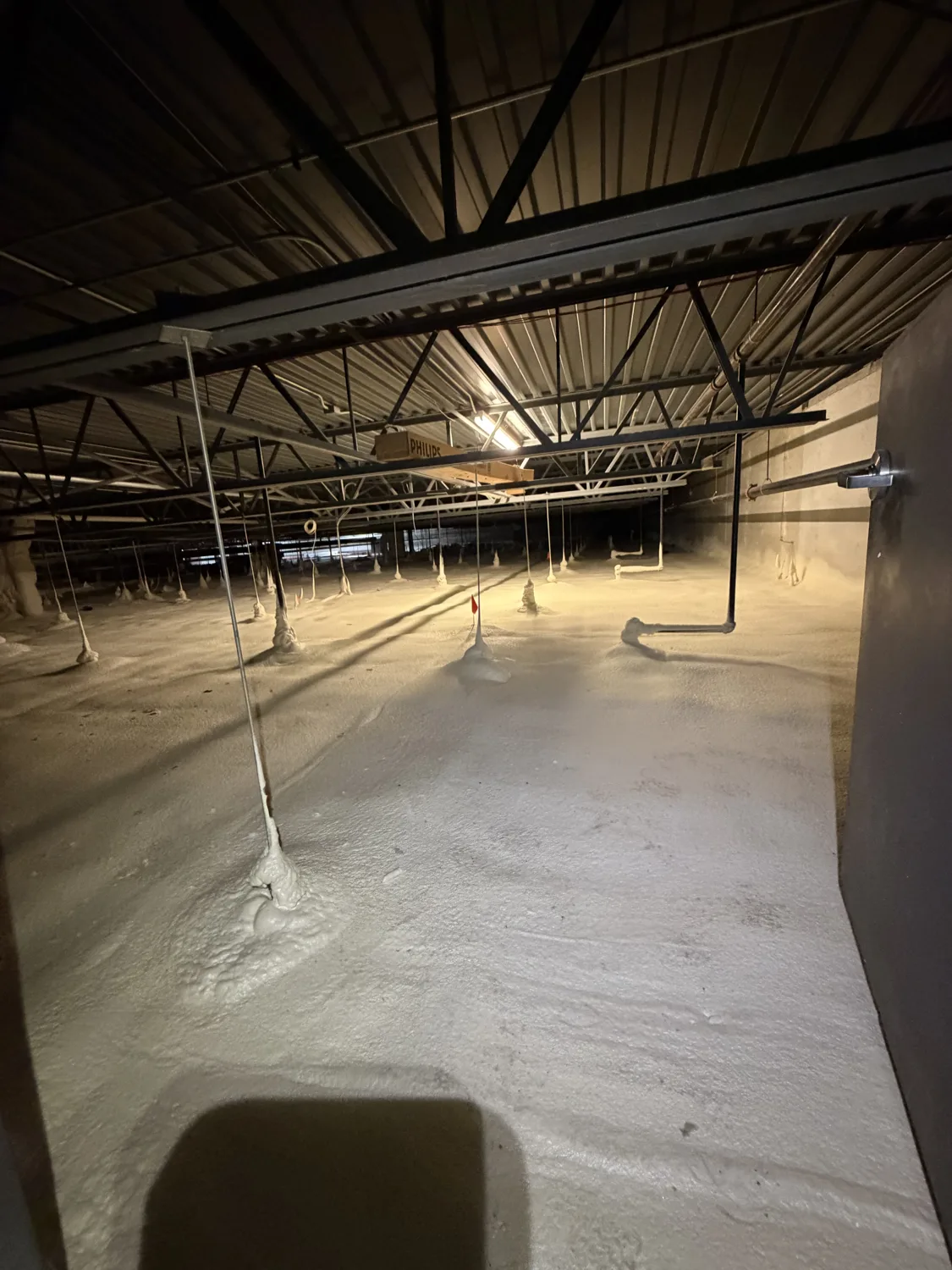
Project photograph: commercial freezer condensation restoration in Carpentersville, Illinois. The full case study documents the original condition and the finished insulation assembly.
At our commercial freezer condensation restoration project, the proposed scope specified nominal 5.5 inches of closed-cell foam for the designated overhead freezer area and approximately four inches for the adjacent refrigerated ceiling, with additional detailing around mechanical penetrations. These were original scope quantities and specifications, not a thickness recommendation for other buildings. The project illustrates how the freezer ceiling, transitions and adjacent refrigerated areas must be considered together when the problem extends beyond a single surface.
Another example is the Green Bay six-inch freezer insulation project. The application was selected to address the conditions reported at that facility. Different temperatures, substrates or existing envelope designs may lead to a different scope even if the visible symptoms look similar.
What about doors, air movement and refrigeration equipment?
A building envelope repair should be coordinated with refrigeration personnel. Door closing time, gasket condition, traffic, the humidity of neighboring spaces, air pressure and equipment operation can continue to influence moisture after insulation is repaired. Where traffic is frequent, the appropriate solution may involve modifying door operation or evaluating the separation between loading and storage spaces.
ASHRAE's Refrigerated-Facility Loads chapter explains that infiltration-related heat and equipment loads may account for a substantial portion of the overall load in some distribution warehouses. This is context-dependent, but the point is valuable: a good insulation project should not be evaluated independently of how the facility operates.
A refrigeration technician should investigate potential defrost, drain or system malfunction. An envelope specialist should review the insulated assembly. Maintenance and sanitation personnel should explain how the space is washed, how products move through it, and what changes during production. Bringing those observations together reduces the risk of paying for a repair that solves only one of several contributing conditions.
What can a manager do now, and when is it urgent?
Treat falling ice, slippery walking surfaces, water near electrical equipment and potentially contaminated production areas as hazards, not merely cosmetic problems. Restrict access and escalate to the facility's safety and engineering teams according to its procedures. Do not enter a suspect overhead area or disturb a deteriorated panel unless the facility has assessed its safety. OSHA's walking-working surface guidance reinforces the importance of controlling wet or slippery surfaces.
A useful first maintenance record includes the affected area, photos taken from safe locations, freezer setpoint and actual temperature, relative humidity in neighboring rooms, door activity, washdown and defrost schedule, weather conditions and prior repairs. Then establish whether refrigeration, plumbing, roofing or the building envelope needs attention. Do not assume that a contractor's ability to remove ice means the source of that ice has been addressed.
How do I know a freezer repair worked?
Review the agreed repairs and inspection documentation before the space is returned to operation. Confirm that the intended insulation and control layers have been completed and that the facility's fire, sanitation and access requirements are met. Schedule observation during representative production and weather conditions. Record whether the previous drip locations, symptoms and temperature patterns recur.
A successful outcome is defined in terms of actual operating conditions, not merely a finished-looking surface. If the owner requires a particular humidity, temperature or condensation performance criterion, document it in the design and contract before awarding the work. Follow-up observations should compare relevant baseline conditions with those after the repair.
2. Can a leaking industrial tank, basin or containment trench be repaired without replacing it?
Often an existing asset can be rehabilitated if its structure remains suitable for continued service or can be restored by an appropriately qualified repair provider. The essential distinction is between damage to a protective lining and damage to a structure that retains liquid or carries loads. A lining is not automatically a structural repair.
There are several common scenarios. An existing coating may be peeling from sound steel. A tank may have localized corrosion that requires qualified assessment and metal repair. A concrete containment trench may have damaged joints or an old lining that no longer resists the chemical exposure. A basin may leak because its seams or penetrations are failing. Those scenarios require different decisions about restoration, testing and the involvement of an engineer.
What to do when a leak is discovered
An active leak of an unknown material, pressurized liquid, hazardous chemical or oil can be a significant safety or environmental event. Follow the facility's emergency response procedures, notify the designated personnel, and have the responsible team determine safe isolation and containment. Do not attempt an improvised coating repair on equipment that is leaking or in service.
After the immediate situation is controlled, identify the asset, its contents, operating pressure and temperature, drawings, construction material, history and applicable inspection requirements. Establish whether the visible leak is in a pipe, fitting, gasket, weld, shell, bottom, concrete joint or lining. Maintenance records, inspection reports and safe external observations are useful starting points.
If a tank is suspected of being structurally compromised, do not infer its remaining strength from the apparent size of a leak or the condition of the surrounding paint. The asset owner needs a qualified assessment before selecting a return-to-service approach.
Inspection comes before choosing the liner
Steel tank assessment may include examination of corrosion, welds, support conditions, settlement, deformation and measured remaining metal thickness. A qualified inspector determines what examination methods are appropriate. Where relevant, the inspector or engineer establishes whether the asset can return to the intended service and whether structural work or replacement is necessary.
The American Petroleum Institute's API 653 inspector program addresses inspection and repair of applicable aboveground storage tanks. API 653 applies to certain steel storage tanks, not every industrial vessel. The correct inspection and repair requirements depend on the tank design, service, jurisdiction and owner requirements. Pressure vessels, chemical tanks, wastewater equipment and concrete containments may have other applicable criteria.
For facilities subject to the oil Spill Prevention, Control, and Countermeasure rule, the EPA tank inspection guidance explains integrity testing obligations and notes that standards such as STI SP001 may be appropriate for some aboveground oil storage containers. A coating installation does not remove those obligations.
Concrete requires a different evaluation. The substrate must be assessed for soundness, contamination, cracks, deterioration and moisture. Moving joints and structural cracks may need specifically engineered details rather than a rigid coating applied across them. AMPP's concrete surface preparation and coating selection guidance explains the importance of assessing these conditions before selecting the preparation and coating system.
What types of lining are available?
There is no universal industrial tank lining. Epoxy systems can provide excellent protection in suitable chemical and immersion environments. Polyurea systems can offer useful flexibility and high-build application characteristics. Other specialized resin systems may be necessary for particular exposures. Performance depends on the actual formulation, the condition of the substrate, system compatibility and the complete service environment.
A meaningful chemical-resistance review requires the identity and concentration of contents, normal and maximum temperature, continuous immersion versus intermittent exposure, cleaning chemicals, exposure duration and possible combinations. Obtain written product suitability information for the entire coating system, including primers, intermediate layers, topcoats and repair details. Do not infer chemical compatibility from the generic family name or from a product's safety data sheet.
A safety data sheet explains hazards and safe handling of a product. A technical data sheet describes application requirements and performance information. Chemical-resistance guidance and specific manufacturer approval serve different purposes again. A tank proposal should identify which documents support the proposed service and whether the manufacturer or engineer needs additional information.
What does a properly scoped lining restoration include?
The proposed work should clarify preparation of the existing substrate, removal of deteriorated coating, evaluation and disposition of defects, treatment of transitions and penetrations, coating system selection, application conditions and final inspection. Requirements depend on the specific materials and design. They should be documented rather than decided after the tank is ready to return to service.
For a concrete asset, a coating contractor may need to coordinate patching or other restoration before lining work. For a steel tank, qualified structural repairs may have to be completed and accepted before a coating can be installed. The work schedule must include access, safe isolation, decontamination where applicable, environmental control, inspection and manufacturer-required cure time. Production downtime is not the same as the time required to spray the protective material.
Many tanks and pits can meet confined-space criteria. OSHA's general-industry permit-required confined-space standard describes requirements for applicable spaces, including coordination with contractors. Construction and other sectors may be governed by different provisions. Entry planning, hazard evaluation, ventilation, rescue arrangements and authorization must be handled by the responsible qualified personnel, not improvised for a quick repair.
Real project example: wastewater tank rehabilitation
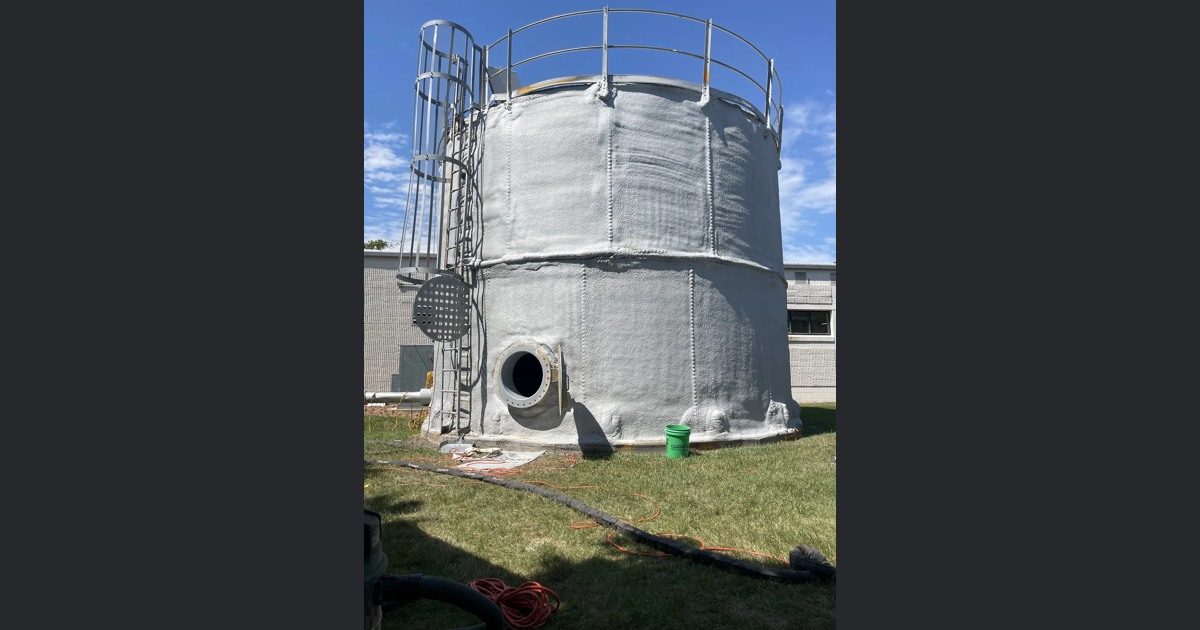
Project photograph: the completed exterior of a wastewater treatment tank. The interior lining and exterior insulation addressed different operating requirements.
The Palmyra wastewater tank lining and insulation restoration demonstrates why the inside and outside of a tank often need separate specifications. The deteriorated interior liner was removed with brush blasting according to the coating manufacturer's specification, and the facility engineering department specified a pure polyurea lining at 100-plus mils for its service conditions. The exterior was insulated and coated to help address cold-weather operation. One mil is one-thousandth of an inch, so 100 mils is 0.1 inch. This is a project-specific thickness.
The project gallery includes the original interior condition and work in progress, as well as the completed exterior. It does not include finished interior photographs. The value of this example is not that every wastewater tank should use the same lining: it is that the internal chemical environment and the external thermal exposure were considered as distinct requirements of the same asset.
See AMPP's wastewater protective coatings guidance for further context on the types of exposure that influence lining selection.
What about a leaking cooling tower?
A cooling tower basin can be affected by corrosion, deteriorated coatings, movement, water chemistry and winter temperature conditions. A leak may endanger equipment or occupied spaces below. Assess the basin and supporting structure first, locate the failure and establish which repairs must be completed before applying a coating or insulation.
Our project portfolio includes a 17th-floor cooling tower basin restoration in Peoria, Illinois. Access and material mobilization were significant constraints. The specified approach included a primer, high-density foam and protective polyurea. It demonstrates the importance of coordinating elevations, access, substrate preparation and the separate functions of insulation and lining. It should not be read as a universal structural repair design.
When should I replace rather than reline a tank?
Replacement or an engineered structural restoration becomes a more important option when the asset has substantial metal loss, incompatible future service requirements, foundation or support problems, widespread damage, or defects whose qualified assessment does not support continued operation. Replacement may also be the better commercial choice when repeated repairs and outages are likely to outweigh the remaining value of the asset.
Compare the alternatives over a common planning period. Consider the cost of equipment replacement, removal and installation, disposal, temporary process capacity, outage duration, inspection, expected maintenance and uncertainty about remaining condition. A less expensive coating proposal can be a poor investment if its assumptions are not supported. Conversely, a documented restoration of a suitable asset can avoid unnecessary removal and installation work.
Ultimately, the decision to return a tank to service belongs to the asset owner and its appropriate engineering and inspection personnel. A contractor's finish photographs are not evidence of tank integrity.
3. How do I stop industrial steel from rusting again?
Corrosion is deterioration associated with the interaction between a material and its environment. On ordinary carbon steel exposed to moisture and oxygen, rust is a familiar visible result. In plants, additional exposures such as salts, chemicals, cleaning processes, repeated abrasion and trapped moisture can increase the risk. The same equipment can experience different corrosion conditions on different surfaces.
The first question is not which paint to purchase. It is why the existing protection is failing. The answer affects what should be removed, how the surface should be prepared, what lining or coating is appropriate and how the asset should be inspected after the work.
AMPP's protective coatings overview describes barrier, inhibitive and sacrificial protection mechanisms. They are different ways of reducing corrosion risk, and some systems combine them. No coating makes maintenance unnecessary.
Where does rust tend to return?
Pay attention to welds, sharp edges, crevices, fasteners, low points, horizontal surfaces where water ponds, penetrations, pipe supports and damaged insulation finishes. Areas receiving frequent washdown or mechanical impact may also fail before the rest of the equipment. A spot that repeatedly rusts despite repainting deserves investigation.
A visual inspection can identify breakdown of the coating or suspicious patterns, but it cannot alone establish remaining steel thickness. If structural loss is possible, obtain a qualified assessment. Do not remove material from load-bearing equipment or conceal suspected structural damage merely to improve the appearance.
Corrosion under insulation is a particular concern because a coating problem or moisture entry pathway may remain hidden. Damaged exterior insulation protection, poor terminations and persistent wet areas can warrant additional evaluation. The correct response may include examining the substrate and redesigning moisture protection, not just sealing over the damaged area. Any removal involving hazardous materials, operating equipment or inaccessible surfaces must be planned by qualified personnel.
Why does new paint peel off old steel?
A coating needs a compatible, properly prepared substrate. Contamination, loosely attached material, insufficient adhesion of older coatings, unsuitable surface profile, uncontrolled environmental conditions and incompatibility between layers can all contribute to failure. Peeling coatings are evidence that the protective system is no longer functioning as intended, but the visible peeling alone does not establish which factor caused it.
Surface preparation has two distinct objectives: achieving the required cleanliness and producing any surface texture required by the selected coating. These should not be confused. The preparation method needs to meet the coating manufacturer's specification and the owner's requirements. Abrasive blasting can be an effective method for many steel surfaces, but it is not always permitted or appropriate in sensitive operating facilities. Qualified mechanical preparation may be an alternative where supported by the specification.
The AMPP coating specification guidance explains the relationship between the substrate, exposure, preparation, coating selection and inspection. A meaningful specification connects these requirements rather than prescribing a material in isolation.
Selecting the protective coating system
For exposed steel, factors include atmospheric corrosion, sunlight, temperature, mechanical impact, chemicals, moisture and desired maintenance intervals. For immersed surfaces, the liquid's chemistry and temperature become especially important. For equipment in food production, the distinction between incidental food contact and direct food contact is material, and cleanability and sanitation requirements should also be established with the owner. Do not assume a coating is approved for a different exposure because its color or generic chemistry is similar.
A multilayer protective system may use a corrosion-resistant primer, a compatible build layer and a weather-resistant finish. Different products serve different functions. Thickness is one performance parameter, not proof that the system is suitable. The entire specified system, including treatment of edges and transitions, matters more than an isolated statement about how many mils were applied.
The asset's original coating history matters too. If existing material is retained, the contractor needs to establish that the retained coating is sufficiently sound and compatible for the approved repair approach. If extensive failure or contamination is present, removal may be required. That decision should be based on inspection and technical guidance, not on the cheapest path to an acceptable-looking finish.
Real project example: restoring historic steel
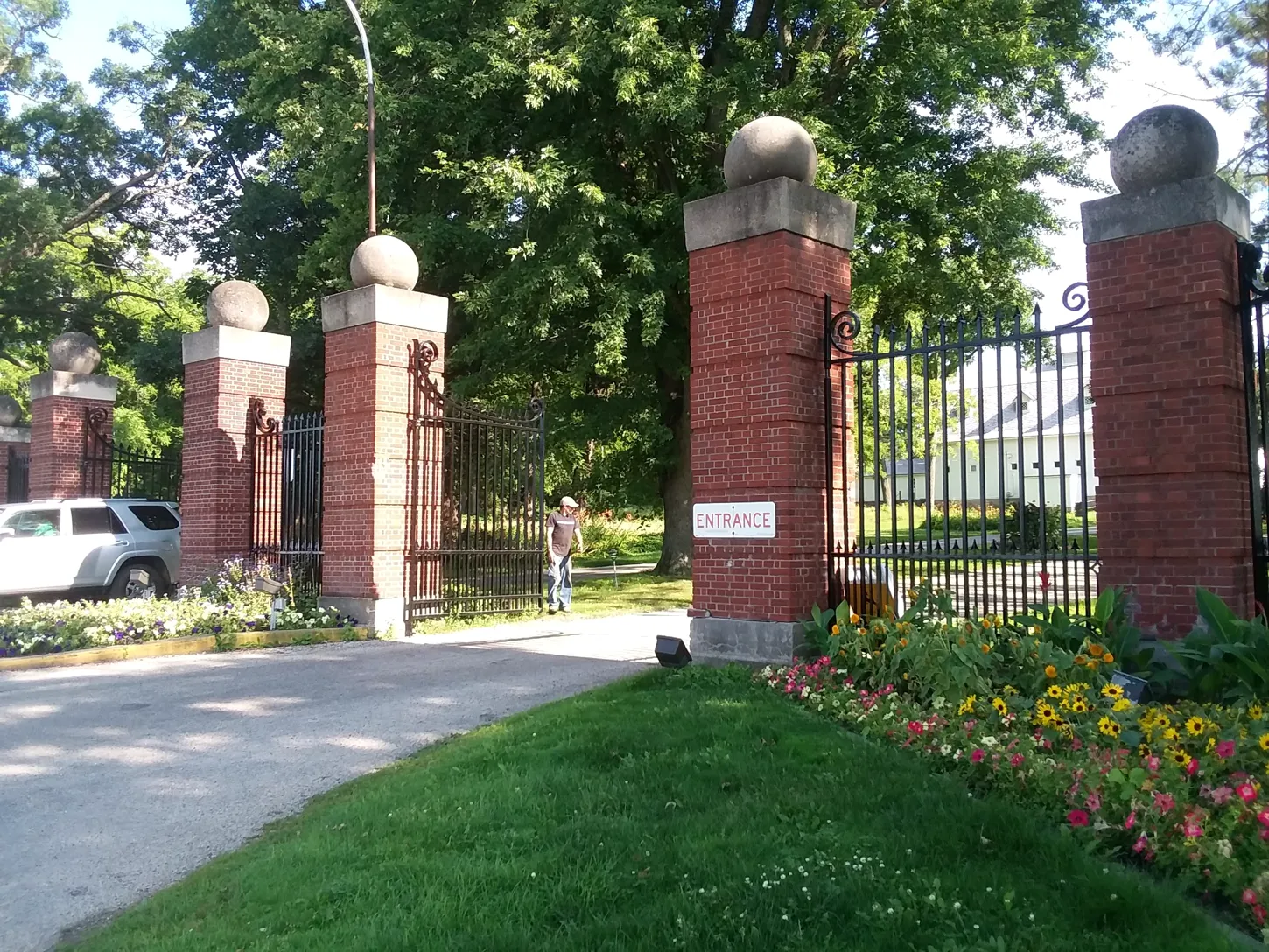
Project photograph: the restored Green Lake Conference Center gates, following fabrication, abrasive preparation and protective coating.
At the Green Lake Conference Center gate restoration, the scope included asset handling, repair and metal fabrication, abrasive blasting, and a high-build black protective coating. The specified system was selected for outdoor use and the desired appearance. This was more than a paint job: damaged portions of the steel were addressed before completing its protective finish.
Industrial steel repair has the same underlying principle even when the equipment looks completely different. The substrate must be suitable for continued use, and the protective system must match the intended exposure. One project cannot establish how long the same coating would last on an unrelated asset under different conditions.
How should corrosion repairs be inspected?
Agree on the acceptance criteria before work begins. Depending on the specification, inspection may involve cleanliness, surface profile, substrate and ambient conditions, coating thickness, continuity testing where appropriate, adhesion evaluation, visual examination and cure verification. The tests selected must be compatible with the substrate, coating and required service. The specified inspection plan is not interchangeable with a generic checklist.
AMPP's measurement and inspection guidance discusses inspection as an important part of quality assurance. Ask who records the results, what equipment and standards apply, what constitutes an acceptable reading, and how nonconforming areas are handled. Obtain a record that maintenance can reference later.
Not every coating system needs every test. The objective is to document the controls and evidence that are meaningful for the asset. Once the equipment is back in service, periodic observations of previously vulnerable areas can identify breakdown before it spreads. Maintain a baseline record so the next inspection can distinguish new deterioration from known conditions.
4. How maintenance and purchasing can turn these symptoms into a clear RFQ
The best bid package is not necessarily the longest. It is the one in which competing contractors are pricing substantially the same problem and acceptance requirements. Start with the outcome and current condition instead of naming a product before its suitability has been established.
- Identify the asset, facility and affected location; provide available drawings and photos.
- Describe the symptom, when it began, when it recurs and the previous attempts to fix it.
- Provide intended operating temperatures, materials, chemicals, cleaning schedules and other relevant exposure information.
- Include any existing coating, insulation or manufacturer documentation and inspection reports.
- Define production restrictions, allowable work hours, access, staging, containment and restoration of the work area.
- Identify the responsible facility contacts for maintenance, engineering, food safety and EHS.
- Request a written proposed scope, assumptions, exclusions, preparation criteria, technical documentation, inspection plan and return-to-service requirements.
- Separate unknown conditions and structural work from the pricing of the protective finish. Establish how changes will be documented and authorized.
When comparing bids, ask whether both contractors are using the same quantity, preparation standard, product system, access conditions and inspection criteria. Are shutdown and cure time included? Who handles equipment isolation and structural repairs? What happens if the underlying condition is worse than expected? What is excluded? Different answers often explain a price difference.
If a supplier promises an immediate cure, permanent prevention of corrosion, or a leak-free tank without knowing the substrate condition and service environment, ask for the technical basis. Responsible contractors should be able to explain the limits of their proposal and where additional engineering or inspection is needed.
5. Frequently asked questions
Can I just add another layer of foam over existing freezer insulation?
Sometimes an approved overlay can be appropriate, but the existing assembly must be evaluated first. Wet, contaminated or deteriorated material, a compromised vapor control layer or a structural issue may require a different approach. The goal is to restore the assembly, not hide water inside it.
Is a thicker coating always better?
No. Coating systems have specified application ranges and requirements. Excessive or inadequate application may cause problems. The target thickness should match the approved system and exposure and be verified according to the inspection plan.
Will coating a leaking tank eliminate the need for inspection?
No. A protective lining is not a certification of structural integrity. Applicable regulatory inspections and engineering requirements still apply. The owner must establish the asset's fitness for the intended service.
Can we do the work while the rest of the plant is operating?
Some scopes can be isolated and scheduled around production; others require shutdown or removal from service. The plan depends on safe access, process hazards, product protection, ventilation, substrate preparation, cure requirements and owner approval. Identify these constraints before setting a work schedule rather than treating containment as an afterthought.
How much does this kind of repair cost?
There is no defensible universal price per square foot without knowing the asset. Access, preparation, substrate deterioration, number of transitions, containment needs, operating restrictions and the selected system can affect cost significantly. Request an estimate that identifies these assumptions and the conditions under which the price would change.
What should I send a contractor to begin?
Provide safe photographs of the affected area, the asset's operating conditions, dimensions or drawings if available, the age and type of existing system, known defects and a desired timeline. If there is an active leak or immediate hazard, the site's emergency response and qualified personnel should address that first.
The next step
The common lesson across industrial freezers, tank linings and steel corrosion is to identify the source of deterioration, assess the asset and then select a compatible repair. Good documentation and a realistic inspection plan make that process easier for maintenance, engineering and purchasing.
If you are evaluating a specific industrial or commercial problem, explore our insulation and spray foam, protective coatings, tank and trench liners, and abrasive blasting and surface preparation services, or request a quote. You can also contact Green Peak directly at contact@greenpeak.us.
Keep reading
More field notes